
This masterclass is based on a simple idea: creating a new djembe rhythm every week. Over the course of a year, I created a collection of 52 djembe rhythms.
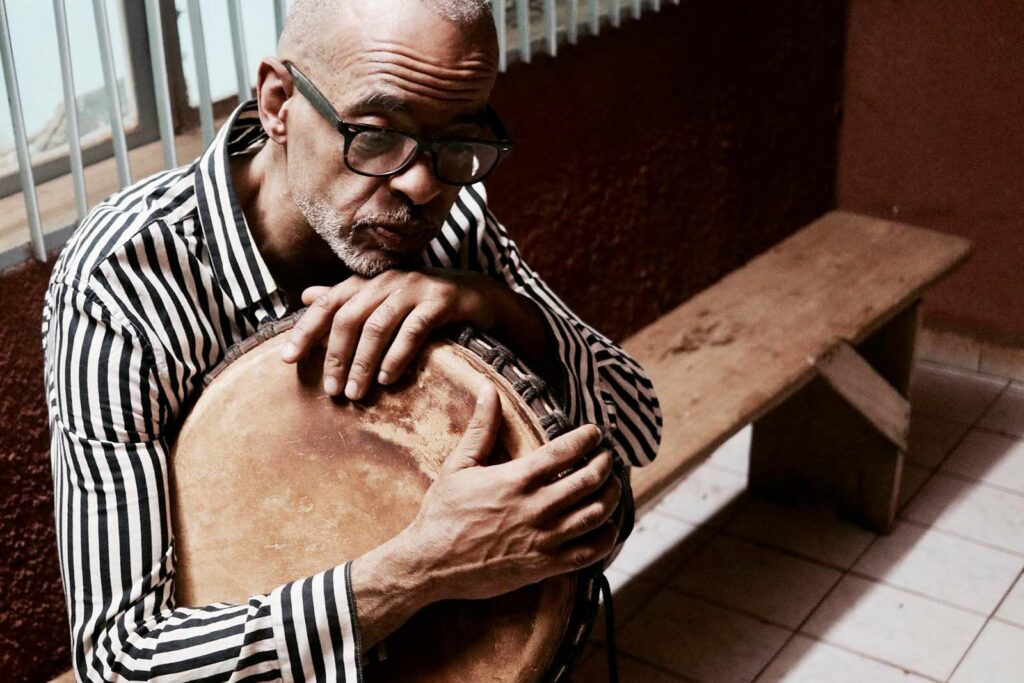
The Origin of the Project
Over the years, I noticed something about the way I naturally play the djembe.
There are moments when I sit down with a drum with absolutely no pressure to produce anything specific. This can happen when I am testing a djembe I have just tuned, when I am preparing for a recording session, or, well, pretty much every time I start playing.
In those situations, I often find myself playing rhythms that are not predefined. They simply appear as I play.
When I was younger, I sometimes recorded these rhythms because I was afraid of forgetting them. At some point, however, I stopped doing that. Recording every idea quickly turned a spontaneous creative moment into a collecting task. More importantly, I eventually realized that the real pleasure was not in collecting rhythms, but in the simple fact that I was constantly able to invent new ones.
Creating rhythms had become a natural and continuous process.
Later, through my work as a teacher, I became more aware of the contrast between two aspects of musical practice. A large part of teaching naturally focuses on transmitting predefined material: rhythms, patterns, structures that already exist and that students must learn. Yet the ability to spontaneously create rhythms is also an essential musical skill.
In fact, inventing a djembe rhythm in real time is already a form of creative practice.
Throughout my musical life, I have been deeply inspired by the example of my mentors. Their playing was not only about reproducing what already existed, but about demonstrating a living musical language. At some point, I began to think that showing this process concretely could also be valuable for my students.
What does it actually mean to invent rhythms regularly?
What does it sound like in practice?
This is how the idea of a self-imposed challenge took form.
One djembe rhythm per week.
Over the course of the year, it resulted in a collection of 52 original djembe rhythms.
This project is therefore not about building a catalog of fixed compositions. It is about demonstrating a process: the simple and ongoing act of inventing rhythms.
This is how the 52 Djembe Rhythms masterclass was created.
The Creative Framework Behind Each Djembe Rhythm
Creativity does not emerge from absolute freedom. Creativity grows from constraints. These constraints may be explicit and conscious, or they may simply exist in the background of one’s musical language. But wherever constraints exist, creativity can develop.
This project is therefore not based on complete freedom. It is built around a set of guiding constraints.
The first constraint is stylistic. I try, as much as possible, not to reproduce already existing traditional rhythms. At the same time, I usually aim to remain within the stylistic language of the djembe. If a listener could imagine that a djembe rhythm might belong to a traditional repertoire, that is often a meaningful indicator for me.
This criterion matters enough to me that it sometimes leads to an interesting situation: from time to time, I realize that a rhythm I have just played is actually very close to an existing traditional rhythm, sometimes only a simplified or slightly embellished version of it.
When playing an existing rhythm, its value has often been proven for decades, if not centuries. An improvised rhythm, on the other hand, has not yet been tested by time. Improvisation always involves a greater degree of risk. It is possible that the rhythm works well, but unlike a traditional rhythm, this is not guaranteed. It is therefore reasonable to accept that the results of improvisation cannot always reach the same level of certainty or originality.
Because of that, I sometimes kept rhythms that are very close to traditional ones. As long as this remained a minority within the project, it does not bother me. Realistically, the fact that a rhythm closely resembles a traditional form is not a flaw at all. On the contrary, it can simply mean that the rhythm fits naturally within the musical language of the instrument. It is only slightly outside the initial ambition of creating entirely new material.
In order to stimulate myself creatively, I sometimes stepped outside the conventional aesthetic and technical framework of djembe playing, exploring unusual sound possibilities and using my hands in ways that are not entirely conventional. At times, this even led me to use techniques that I would normally criticize when used by people who have never really learned the instrument and tend to play the djembe in rather questionable ways, at least from the perspective of someone who has gone through a formal learning process.
Another constraint concerns rhythmic structure. I am generally not particularly attracted to odd meters beyond three beats. Rhythms in five, seven, or even more unusual divisions such as three-and-a-half beats do not naturally belong to my preferred musical territory.
These constraints, together with this margin of flexibility, created the space in which the rhythms of this project emerged.
From Idea to Recording a Djembe Rhythm
To preserve the spontaneity of the creative process, I first captured these ideas in the simplest way possible.
Whenever a rhythm appeared, I simply recorded it on my phone without worrying about sound or image quality. What mattered was capturing the musical idea itself.
I then returned to these recordings in my studio. I scrolled through the ideas stored on my phone and selected the rhythms that I liked the most.
At that point, I recorded them again in a more deliberate way, with proper audio and video recording conditions.
The funny part is that I had to learn some them as if someone else was showing them to me!
What’s inside 52 Djembe Rhythms?
The rhythms are accompanied by transcriptions, and also include explanations of the specific hand techniques used to play them. The idea is to make all the necessary material available so that you can reproduce these rhythms.
However, the deeper goal of this project is not simply imitation. The real intention is to encourage each of you to engage in your own creative process. If these rhythms inspire you to experiment with your own ideas on the djembe, then the project achieves its purpose.
These rhythms can also be approached as a kind of laboratory. You may start by learning one of them, then try to modify it, simplify it, extend it, or transform it into something new. In that sense, each rhythm can become a starting point rather than a finished model.
Used this way, the collection serves not only as repertoire, but also as a practical tool for developing personal creativity on the instrument.
If you are already enrolled in the Membership, the 52 Djembe Rhythms masterclass will automatically appear in your dashboard when it is released. Otherwise you can join the waiting list below to receive the launch offer.