
Shifting is a structural principle in djembe solo playing that allows a simple pattern to generate tension by moving across the cycle in a different metric than the groove.

Shifting in Djembe is not about speed.
It is not about density.
It is not about complex rhythmic vocabulary.
It is about repeating a simple pattern in an unexpected way.
This process is what I call Shifting.
Shifting happens when a pattern is repeated inside the cycle using a metric different from the groove. The pattern itself does not become more complicated. What changes is its placement.
The effect can span one measure, a pair of measures, or more.
Shifting in Djembe: Two Divisions of Time at Once
Shifting creates tension because two divisions of time coexist until the shift is resolved.
The groove continues in its original metric framework.
The repeated pattern follows another internal logic.
Both are present simultaneously.
This coexistence is what creates that suspended sensation often heard in powerful DJEMBE solos. The groove is still there, but something seems to slide across it.
One of the simplest examples of this mechanism, often used in Western music, is the famous 3 over 4. A steady three-note grouping repeated over a four-beat framework.
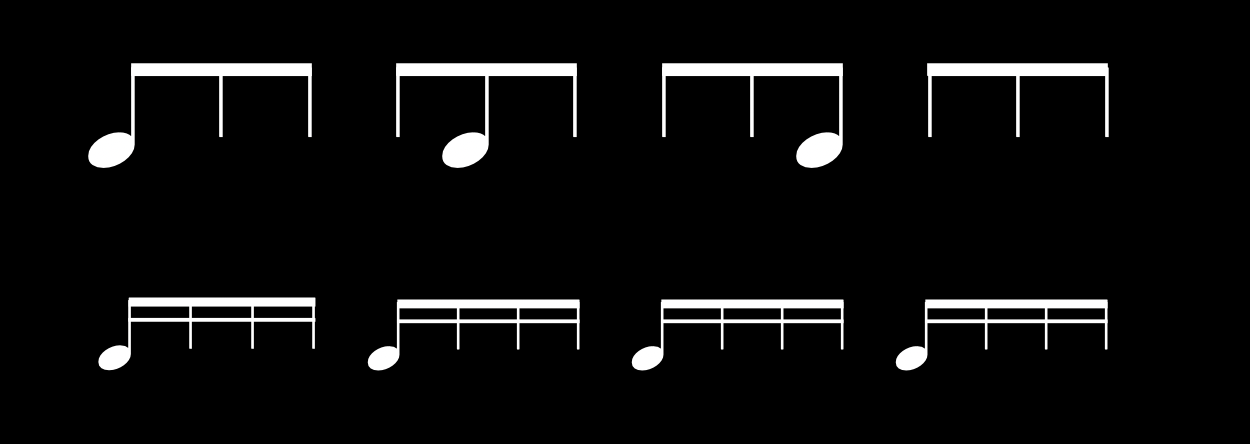
The principle is not foreign to other traditions either. In Indian classical music, metric displacement and cyclic tension are developed extensively.
How It Appears in Djembe Music
In DJEMBE music, shifting generally takes shape through a small number of established formulas. The resolution rarely extends beyond one or two pairs of measures.
This is not a limitation.
It reflects the nature of a community-based musical tradition.
DJEMBE music is popular dance music. It is celebratory and collective. Its complexity naturally stops before becoming detached from its festive function.
The shift appears, creates tension, and resolves. Everybody expects the return to the form. This return can occur either by sliding into another pattern that reconnects with the repetition of the accompaniment groove, or the shifting can resolve through a conclusion signal.
What the Upcoming Course Will Explore
The course will approach shifting step by step:
- Moving from beat awareness to true cycle awareness
- Understanding how repetition stabilizes a groove
- Introducing metric contrast inside a stable framework
- Shifting two-beat patterns and single sounds
- Exploring different degrees of displacement
- Learning how to resolve with conclusion signals
- Linking multiple shifts in both binary and ternary contexts
The goal is to understand how a simple idea, placed differently, can transform the entire perception of rhythm.
If you are already enrolled in the Membership, the Shifting course will automatically appear in your dashboard when it is released. Otherwise you can join the waiting list below to receive the launch offer.