
“The African approach to rhythm does not flourish through tempo control, but through the physical sensations produced by movement.”
Beginning in the late 1980s, with the arrival of Famoudou Konaté in Germany through the initiative of Paul Engel and Sylvia Krönwald, a new pedagogical approach aimed at Western students began to take shape. The emphasis was placed on the explicit identification of tempo and on distinguishing binary from ternary rhythms in order to help European students orient themselves within the rhythms.
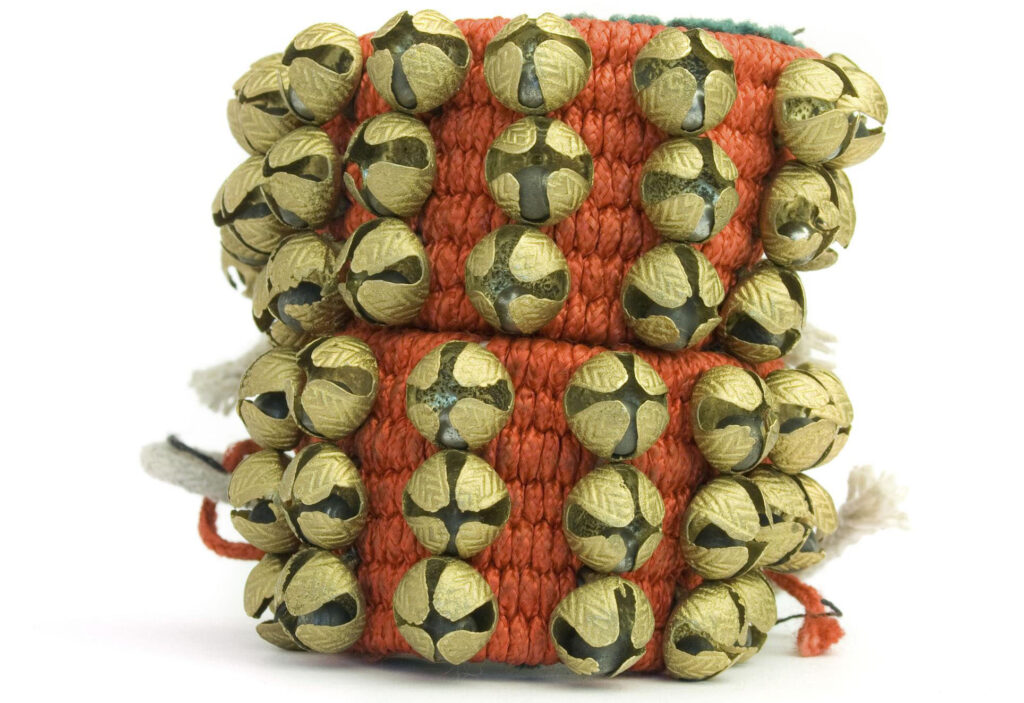
Mamady Keïta would later formalize this approach more explicitly through the use of an ankle bell bracelet marking the tempo.
I therefore experienced a period in which this explicit metric reference did not exist in the way African musicians taught djembe. Then came a period in which it became omnipresent and was perceived by Western students as proof of pedagogical competence, which was precisely the message Paul Engel wanted to communicate: this master is different, he can explain the rhythms, explain where the tempo is, where the “one” is.
This pedagogical shift moved the focus toward tempo control, at the expense of what I believe lies at the core of oral transmission: a physical understanding of rhythm based on gesture, movement, and the sensations they produce.
Trying to Understand Rhythm Intellectually
At the beginning of my journey, I also tried to understand intellectually where the tempo was located in the rhythms that caused me difficulties.
I perceived the metric placement of some rhythms incorrectly.
Because of my previous musical education (I studied violin at the conservatory for several years), I was capable of analyzing a rhythm and understanding mentally how it worked.
But as soon as I found myself in real situations with musicians playing with full energy, that analytical understanding was not enough to compensate for my lack of real rhythmic perception, and I became lost again.
It was a reality for which I had no functional intellectual solution. So eventually, I let go.
I found myself forced to accept that I could only play certain rhythms if someone started them for me first, meaning that someone would first play the rhythm, I would join by imitation, and then that person would stop while I continued alone.
At first, this situation was frustrating. Nevertheless, I was forced to acknowledge that what I had hoped would be a shortcut for integrating difficult rhythms was only sufficient to allow me to talk about those rhythms, but absolutely not sufficient to play them with people performing them outside of an educational setting.
With the most difficult rhythms, I was aware that I was not perceiving their placement correctly, while still being capable of maintaining the corresponding chain of movements.
The Power of Oral Transmission
It was ultimately over the course of months, through repeating these chains of movement and experiencing these sensations, that I eventually began hearing the rhythms correctly and understanding the power of oral transmission and the validity of its functioning, which prioritizes feeling over intellectual understanding.
Every time I found myself struggling, instead of trying to understand intellectually, I abandoned myself into the movements.
Little by little, it became clear that this was the shortest path toward learning to play these rhythms with emotion.
You must learn their physical gestures.
At that time, the African teachers I encountered (pre-Paul Engel / Famoudou Konaté) sought to make students physically feel the movement of the rhythm, the chain of gestures producing it.
Analytical observation of how the rhythm functioned was not part of the conversation.
As with certain repetitive forms of manual labor, a movement executed cyclically naturally generates a rhythmic system.
Djembe rhythms themselves are also based on chains of movement regenerating each time the cycle returns. It is the sensations produced by this loop of movement that one must progressively learn to feel.
What is at stake here is physical sensation, not intellectual visualization of rhythm.
This approach, grounded from the earliest stages of learning in the physical sensation of rhythm, is closely linked to the aesthetic nature of this music itself.
My Own Teaching Approach
As a teacher, I now position myself somewhere between oral transmission and an analytical approach to rhythm.
A person learning djembe outside of its African cultural context is deprived of a huge amount of information naturally transmitted through environment, dance, songs, movement, body language, and daily immersion in this music.
I therefore use certain tools coming from the Western approach, such as rhythm notation and some aspects of intellectual understanding.
However, I do not teach strikes organized around an abstract tempo.
I teach repeating patterns, chains of movement and sensations returning cyclically.
And in my opinion, this difference is fundamental.
My playing entered an entirely different dimension from the moment I accepted, as a student myself, to focus on the sensations produced by movement rather than on the intellectual visualization of rhythms.
A Different Rhythmic Logic
African rhythms are based on a logic different from Western rhythms.
In Western music, even when several instruments are played simultaneously, the overall rhythmic intention moves in the same direction.
It is not polyrhythm, but rather a single rhythm whose certain timbres are reinforced by doubling them.
I am giving here a somewhat reductive description of the drum set. Nevertheless, this is generally how it is played, except in styles derived from African music.
In that case, rhythm obeys tempo.
In African rhythms, the logic is different.
Rhythmic motifs are not organized in relation to tempo, but in relation to one another.
Each motif responds to another, completes it, extends it, sometimes contradicts it, creating tensions and resolutions.
And the whole of these rhythms does not follow a tempo: it generates one.
This is also why the physical sensation of movement plays such an important role.
The musician is not trying to stay “in tempo.” Through energy and through the quality of gesture, the musician nourishes the relationship between the different rhythmic movements interlocking with one another.
How to Watch Djembe Videos
In the DJEMBESOLO PATTERNS course, I therefore provide rhythm and pattern transcriptions for informational purposes.
However, I believe that the essential information being transmitted is not found in the transcriptions, but in observing the movements executed in the videos.
Do not focus only on the impact at the moment the hand touches the skin, but on the entire trajectory of each gesture, because that impact is the result of the entire movement preceding it.
“The African approach to rhythm does not flourish through tempo control, but through the physical sensations produced by movement.”
Try the DJEMBESOLO PATTERNS course risk-free for 30 days.*
*If DJEMBESOLO is not the right fit for you, you can request a full refund within 30 days. No questions asked.